
On View
Not on viewObject number1960/1.436
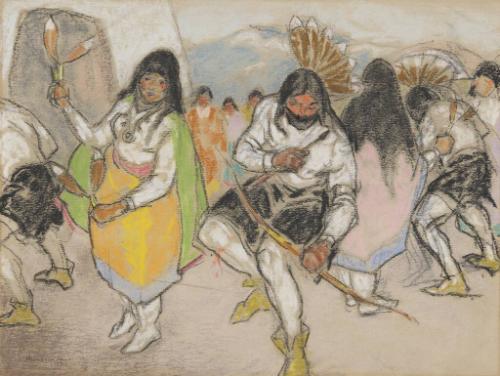
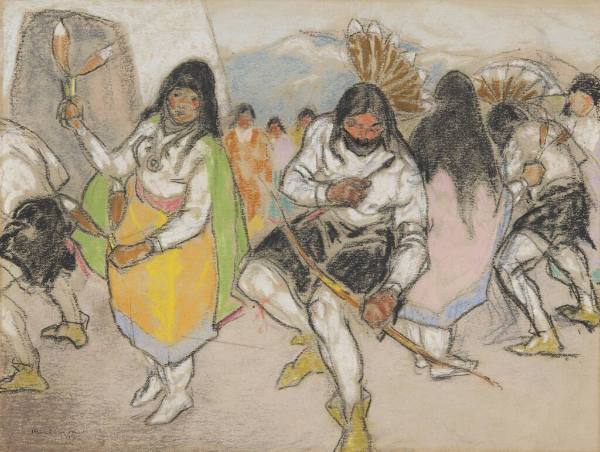
Snow Bird Dance
Artist
William Penhallow Henderson
(American, 1877 - 1943)
Date1917
Mediumpastel on paper
Dimensionsmat: 20 × 24 in. (50.8 × 61 cm)
image (flush): 9 1/4 in. × 12 in. (23.5 × 30.5 cm)
image (flush): 9 1/4 in. × 12 in. (23.5 × 30.5 cm)
Credit LineGift of Miss Fillette Many
Label TextWilliam Penhallow Henderson was an established artist and teacher in Chicago when his wife’s tuberculosis diagnosis prompted the family’s relocation to New Mexico in 1916. By this time, New Mexico had a reputation among white Americans as a destination for health and recovery, a narrative shaped by the region’s climate and advertisements encouraging settlement and tourism.
Having visited Santa Fe as a child and later studied religion as a young man, Henderson—alongside his wife Alice, a writer—soon focused on capturing the religious and cultural life of the region’s Indigenous and Hispanic communities. In Snow Bird Dance, Henderson depicts a ceremonial dance frequently portrayed in early twentieth-century art and tourism imagery of the San Ildefonso Pueblo. Such dances, often observed by visitors with limited understanding of their cultural importance, circulated widely as images of Indigenous life and helped shape romanticized and exoticized perceptions of the Southwest, fueling the region’s tourism economy.
[Label Text: For the People: America at 250 Exhibition, June 27 - October 4, 2026]
***********************
William Penhallow Henderson was already an established artist and art teacher in Chicago when his wife’s illness with tuberculosis led the family to relocate to New Mexico in 1916. By this time New Mexico had a decades-old reputation as a salubrious destination for white Americans with health struggles – a reputation grounded in the Southwest’s warm climate and the false narrative that native New Mexicans were immune to “consumption” because of it – that was intentionally stoked by territorial leaders in the late nineteenth and early twentieth centuries in an effort to encourage the growth of the territory’s white population.
Having visited Santa Fe as a child and studied religion as a youth, it is perhaps unsurprising that Henderson (alongside his wife Alice, a writer) took a serious professional interest in the religious cultures of the region’s Indigenous and Hispanic peoples soon after arriving in 1916. The Snow Bird Dance, pictured here, was a subject featured in depictions of San Ildefonso Pueblo by numerous early twentieth century artists. Henderson’s drawing recreates and reiterates touristic fascination with Indigenous ceremonials that helped make them arguably the Southwest’s greatest attraction to white visitors in the early twentieth century. Though tourists typically knew little about the religious or cultural significance of such ceremonies, the elaborate costumes and dances that they incorporated fueled the fires of exotic fascination that propelled the region’s tourism industry as a whole.There are no works to discover for this record.