On View
On viewObject number1977/8.23
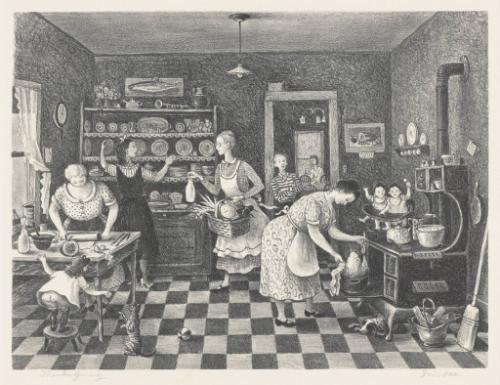
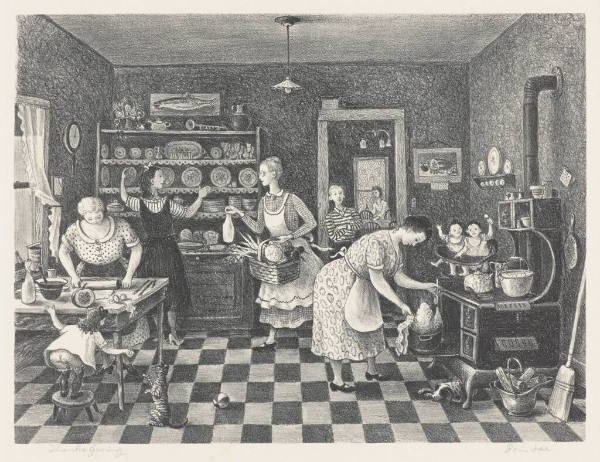
Thanksgiving
Maker
Doris Emrick Lee
(American, 1905 - 1983)
Date1942
Mediumlithograph
Dimensionsmat: 16 × 20 in. (40.6 × 50.8 cm)
sheet: 12 × 17 1/16 in. (30.5 × 43.3 cm)
image: 8 3/4 × 11 3/4 in. (22.2 × 29.8 cm)
sheet: 12 × 17 1/16 in. (30.5 × 43.3 cm)
image: 8 3/4 × 11 3/4 in. (22.2 × 29.8 cm)
Credit LineBequest of Mrs. Cornelia Robinson
Exhibition History"A Century of Caring: One Hunderd Years of American Realism," KIA (May 18 - Aug. 3, 1986).
"36 Regionalist prints from the KIA," Dennos Museum Center (Sept. 8 - Nov. 24, 1996), Ella Sharp Museum, Jackson, MI (May 17 - July 13, 1997), Midland Center for the Arts (Aug. 2 - Sept. 21, 1997).
"The Woman as Subject: Selections from the Permanent Collection," KIA Long Gallery (June 13 - Sept. 8, 2003).
"Celebrate!" KIA KIA Upjohn Mason Grandchildren Interactive Gallery (September 23, 2023 - January 14, 2024)
Label TextDoris Lee became known for scenes of everyday American life inspired by her Midwestern upbringing. Thanksgiving depicts the busy preparations the holiday meal entails, showing family members—most notably all women—cooking, setting the table, and gathering for a shared meal.
The original painting, held in the Art Institute of Chicago’s collection, premiered in 1935 during the Great Depression and was well-received because it focused on abundance, domestic life, and family. Interestingly, small details like the women’s dresses, a perched cat, and the entire removal of one coat-cloaked lady differentiate the Thanksgiving print from the painting. At a time of widespread economic hardship and global conflict, Lee’s portrayal of this American holiday offered a reassuring message of togetherness. As a result, since its debut, Thanksgiving has been widely recognized as one of the most popular representations of the holiday for its depiction of the shared rituals that help shape American cultural identity.
[Label Text: For the People: America at 250 Exhibition, June 27 - October 4, 2026]
******************************
One of a large family from Aledo, Illinois, Doris Lee grew up surrounded by all the comforts and pleasures available to an affluent family in a small Midwestern town. After college she studied art, first in Kansas City and later in Paris, where she adopted the style of the abstractionists then in vogue. On her return to America in 1930, she went to San Francisco where she studied with Arnold Blanch (later her husband), who advised her to paint subjects that she understood. She then began to concentrate on the reminiscences of her childhood and scenes from the world around her, subjects that occupied her for the rest of her life. Thanksgiving, drawn from memories of the holiday in her childhood home, is based on a painting by Lee now in the collection of the Chicago Art Institute.