On View
On viewObject number1972/3.44
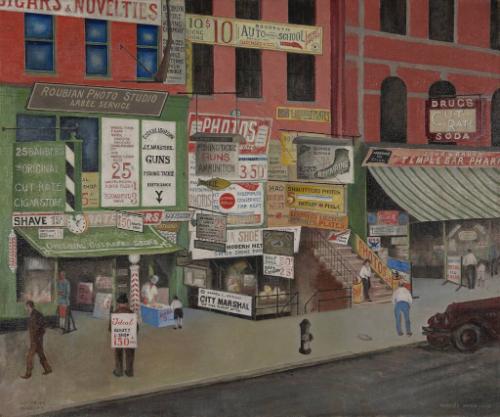
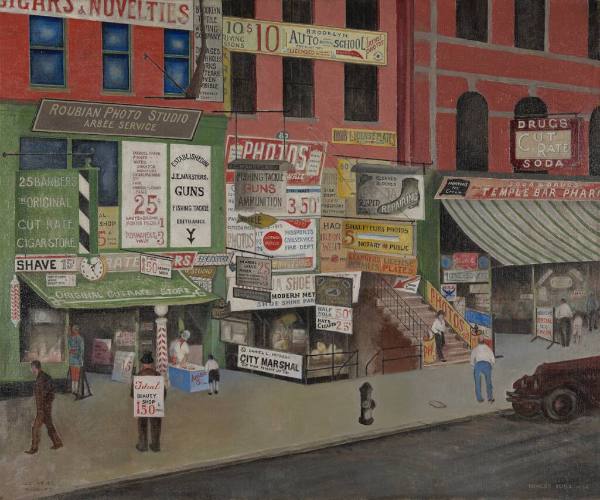
Court Street, Brooklyn N.Y.
Artist
Miklos Suba
(American, 1880 - 1944)
Date1934
Mediumoil on canvas
Dimensionsimage: 24 3/4 × 29 3/4 in. (62.9 × 75.6 cm)
frame: 29 1/2 × 34 in. (74.9 × 86.4 cm)
frame: 29 1/2 × 34 in. (74.9 × 86.4 cm)
Credit LineGift of Mr. and Mrs. Donald S. Gilmore
Exhibition History"Miklos Suba," KIA (Mar. 1964).
Label TextCityscapes such as Court Street, Brooklyn, N.Y. captured the dense commercial energy and visual intensity of early twentieth-century urban America. During this period, many artists and patrons were drawn to scenes of working-class neighborhoods, often framing the lives of these communities as more “authentic” or “real” than their own culturally refined environments.
Miklós Suba, an architect and painter trained in Budapest and Vienna, immigrated to Brooklyn from Hungary in 1924. During the last two decades of his life, he produced numerous views of Brooklyn, including Court Street, Brooklyn, N.Y. Rather than treating the American city as a spectacle for observation, Suba presented it as a place of recognition and connection, shaped by routine movements, commercial activities, and everyday urban life.
[Label Text: For the People: America at 250 Exhibition, June 27 - October 4, 2026]
*******************************
As much as any painting on display here, Court Street, Brooklyn N.Y. epitomizes what art historians and curators have labeled “American realism” over the last century – representations of the everyday lives of lower- and middle-class people, especially in New York City. Cityscapes like this one captured the hustle and bustle and the garish, heavily commercialized visual environment of an early twentieth-century metropolis. The persistent interest in these subjects seems rooted in two ideas, both founded in elitism: that the experiences of the working poor in the modern city were somehow more “real” than most, and that the often-luxurious lives of many artists and art patrons were, by contrast, less authentic. Miklos Suba was an architect and painter who received extensive training in Budapest and Vienna, and was therefore not a part of the “huddled masses” of poor European immigrants who famously flocked to New York City during the late nineteenth and early twentieth centuries. He immigrated to Brooklyn from Hungary in 1924, swiftly growing familiar with his new surroundings. Unlike those of many of his contemporaries, the countless paintings that he produced of the borough over the last twenty years of his life seem more rooted in familiarity and fondness than voyeurism. ["American Realism" Exhibition Label, 2023]