
On View
On viewObject number1999.46
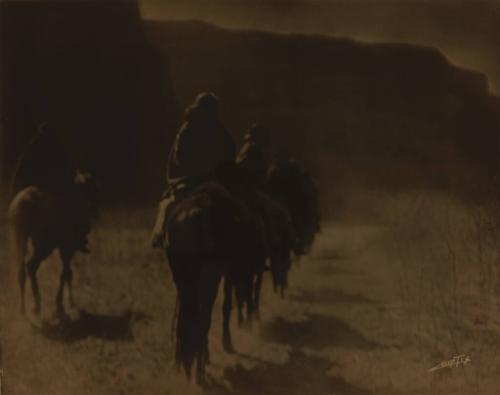
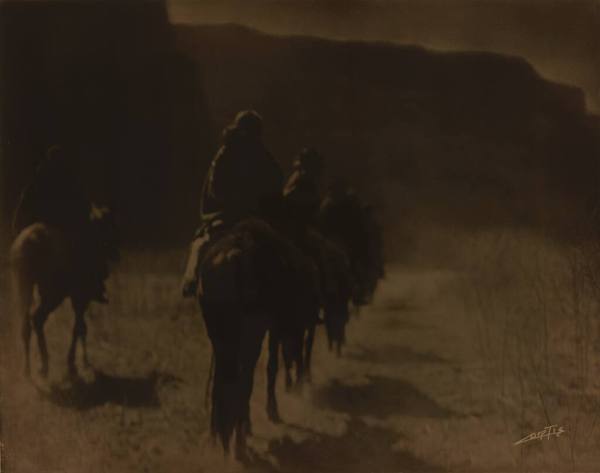
The Vanishing Race, Navaho 1904
Maker
Edward S. Curtis
(American, 1868 - 1952)
Date1904
Mediumorotone
Dimensionsimage: 11 × 14 in. (27.9 × 35.6 cm)
frame: 14 1/2 × 17 5/8 × 1 1/4 in. (36.8 × 44.8 × 3.2 cm)
frame: 14 1/2 × 17 5/8 × 1 1/4 in. (36.8 × 44.8 × 3.2 cm)
Credit LineGift of Jon Stryker and Robert Schram
Exhibition History"Focus on New Acquisitions: 1998-2000," KIA Long Gallery (Feb. 9 - Aug. 11, 2001).
Label TextEdward Curtis was a photographer, ethnographer, and filmmaker known for his extensive documentation of Indigenous peoples across North America. Over his career, he produced tens of thousands of photographs, as well as audio and motion picture recordings, depicting more than 80 Indigenous nations in the twenty-volume series The North American Indian.
The Vanishing Race is one of Curtis’s most recognized images, showing a group of Diné (Navajo) on horseback, riding away from the camera into an open landscape. Curtis’s accompanying text states that the image reflects his belief that Indigenous peoples were “passing into the darkness of an unknown future.”
This framing reflects the widely circulated “vanishing race” notions of the era, which portrayed Indigenous cultures as disappearing in the face of Euro-American expansion. Contemporary scholarship has critically reassessed Curtis’s work, highlighting how his photographs helped reinforce stereotypical and inaccurate representations of Indigenous peoples.
[Label Text: For the People: America at 250 Exhibition, June 27 - October 4, 2026]
*******************************
Edward Curtis is known for his depictions of Indigenous North Americans conducted over a long career spent traveling in the American West and documenting the lifeways of more than 80 different Native tribes through both photographs and audio and motion picture film recordings. His photographs, which eventually numbered more than 40,000 negatives, were published in a twenty-volume series, The North American Indian, that was produced with the financial backing of banker J.P. Morgan.
The Vanishing Race has long been perceived as both Curtis’s signature photograph and the symbolic key to understanding his approach toward Native peoples. It depicts a group of Diné (formerly called Navajo) on horseback riding off into the gloomy distance, seemingly without excitement or hope for the future. Curtis conveyed some of his intentions for the photograph in the text he wrote to accompany it in The North American Indian: “The thought which this picture is meant to convey is that the Indians as a race, already shorn in their tribal strength and stripped of their primitive dress, are passing into the darkness of an unknown future.” The “vanishing race” concept crystallized in Curtis’ photograph asserted the widely held notion that America’s indigenous peoples and their traditional lifeways were disappearing in the face of their encounter with Euro-Americans, whose supposed racial superiority was eroding Native traditions and diminishing their numbers. Though framed as a lament that motivated Curtis’ documentary practices, this concept helped to justify perceptions of white racial supremacy and Native inferiority and helplessness. Recent research on Curtis has focused on how his photographs and publications, and especially The Vanishing Race, have continued to perpetuate inaccurate and condescending stereotypes about Native Americans in the time since they were produced.There are no works to discover for this record.