On View
On viewObject number2002.19
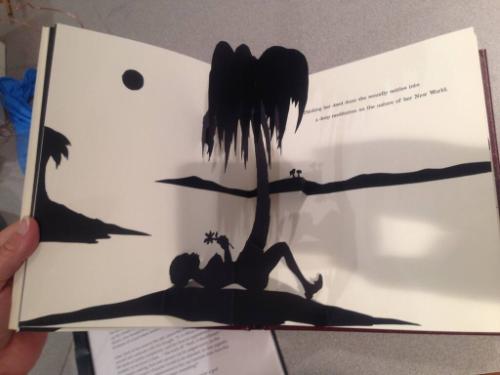
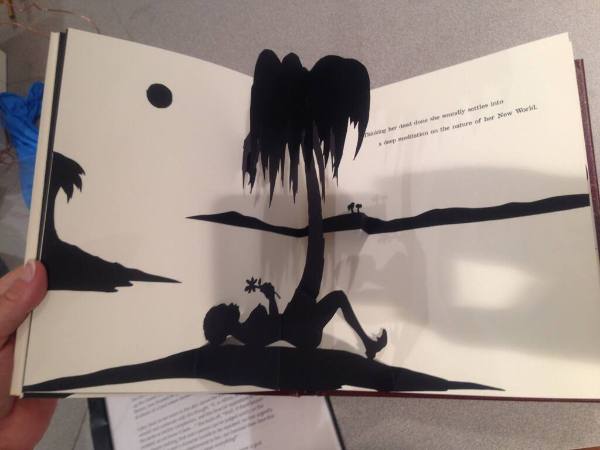
Freedom: A Fable
Artist
Kara Walker
(American, 1969-)
Date1997
Mediumpaper, laser-cut
DimensionsOverall: 5/8 × 9 3/8 × 8 1/4 in. (1.6 × 23.8 × 21 cm)
Credit LineGift of Angela Graham and Don Desmett
Exhibition History"New Accessions to the Permanent Collection," KIA Long Gallery (Dec. 7, 2002 - Feb. 23, 2003).
"Embracing Diverse Voices: African-American Art in the Collection of the Kalamazoo Institute of Arts," KIA Galleries 3&4 (Oct. 3 - Nov. 29, 2009).
"Embracing Diverse Voices: 90 Years of African-American Art," KIA Traveling Exhibition, Tyler Museum of Art, Tyler, TX (January 17 - March 20, 2016).
"Embracing Diverse Voices: A Century of African-American Art," KIA Traveling Exhibition, North Carolina Central University Art Museum (October 7 - December 12, 2016).
"Resilience: African American Artists as Agents of Change," at the KIA (September 14, 2019 - February 16, 2020)
"Resilience: African American Artists as Agents of Change," [Travel Version] at the Dennos Museum Center, Traverse City, MI (June 6, 2021 - August, 15, 2021)Label TextKara Walker reimagines the 18th- and 19th-century practice of cut-paper silhouette portraits, creating dramatic, unfolding panoramic scenes of the Antebellum South. These works draw on early American narratives that recast racial stereotypes and plantation mythologies, evoking imagery of African Americans from minstrel shows, novels, and advertisements. Simultaneously unsettling and compelling, Walker’s compositions challenge outdated understandings of the Antebellum period, presenting the realities of a time of terror and intimidation for those who were enslaved or freeborn people of African ancestry.
In Freedom, A Fable, the artist employs this approach to a book of illustrations, text, and pop-up silhouettes, telling the story of a formerly enslaved woman whose life after emancipation is far from her hopes and expectations. Intended for individual consumption, this work encourages viewers to consider the physical and psychological harms experienced during enslavement and its aftermath.
[Label Text: For the People: America at 250 Exhibition, June 27 - October 4, 2026]
**************************
Kara Walker has introduced a unique voice in contemporary art with her appropriation of the 18th and 19th-century practice of cutting paper portrait silhouettes, recreating narratives from the Antebellum South that re-define racial stereotypes and plantation mythologies. In the 1997 catalogue for her exhibition at the San Francisco Museum of Modern Art, Walker describes how "The silhouette says a lot with very little information, but that's also what the stereotype does. So I saw the silhouette and the stereotype as linked. Of course, while the stereotype, or the emblem, can communicate with a lot of people, and a lot of people can understand it, the other side is that it also reduces differences, reduces diversity to that stereotype." In 2006 the artist was invited to juxtapose works from the permanent collection of the Metropolitan Museum of Art, New York, with her own art work as a response to the Hurricane Katrina catastrophe.