On View
Not on viewObject number2006.66
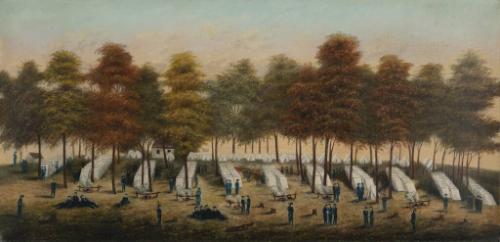
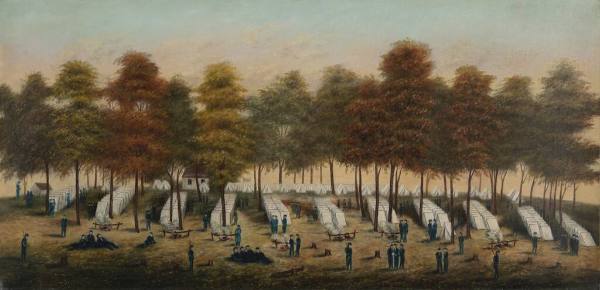
Union Army Encampment
Artist
Johann Mongels Culverhouse
(Dutch, 1820 - 1891)
Dateca. 1860
Mediumoil on canvas
Dimensionsimage: 16 1/2 in. × 34 in. (41.9 × 86.4 cm)
frame: 24 1/2 × 42 × 1 1/2 in. (62.2 × 106.7 × 3.8 cm)
frame: 24 1/2 × 42 × 1 1/2 in. (62.2 × 106.7 × 3.8 cm)
Credit LineElisabeth Claire Lahti Fund
Exhibition History"Warhol, Chihuly and Others: Showcasing New KIA Acquisitions," KIA (Dec. 8, 2007 - Jan. 27, 2008).
"A Legacy for Kalamazoo: Works Acquired through the Elisabeth Claire Lahti Fund, 1998 - 2012," KIA (Sept. 29, 2012 - Jan. 20, 2013).
"Legendary Voices: Art for the Next Century," KIA (September 7 - February 18, 2025)Label TextThis painting speaks to the enduring influence of the Civil War on American history and memory. Johann Culverhouse’s Union Army Encampment depicts the busy activities of a camp of blue-clad Union soldiers, capturing a moment at either the end of the conflict or shortly thereafter. The painting suggests the artist’s desire not only to document but also to preserve this historic moment for future generations.
Union Army Encampment reflects the widely held belief that the Civil War would be remembered as a defining event in the nation’s history. Beyond the staggering loss of life—numbering in the hundreds of thousands—the conflict prompted important social, economic, legal, and political shifts that continue to impact the United States today.
[Label Text: For the People: America at 250 Exhibition, June 27 - October 4, 2026]
****************************
This painting speaks to the lasting power and influence of the Civil War in American memory. Culverhouse’s picture, produced as the conflict unfolded, shows a Union camp busy with the activity of soldiers. Even at the time, there was a feeling that the War was a period of great importance in the nation’s history. Mostly due to the hundreds of thousands who died during the conflict, it left a permanent impact on many of the nation’s citizens, and prompted many social, economic, legal, and political changes. Wrote author Robert Penn Warren in 1961, the Civil War was "our felt history, history lived in the national imagination... It draws us as an oracle, darkly unriddled and portentous, of personal as well as national fate." [From Legendary Voices exhibition, 2024-25]