On View
Not on viewObject number2008.27
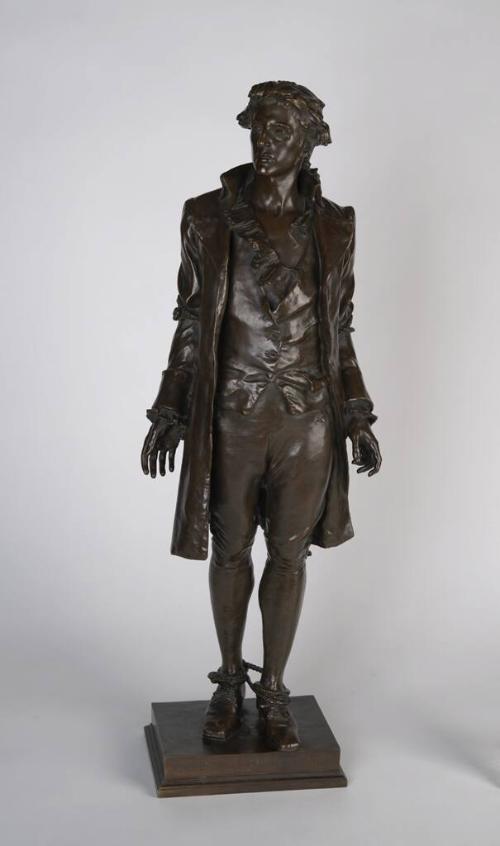
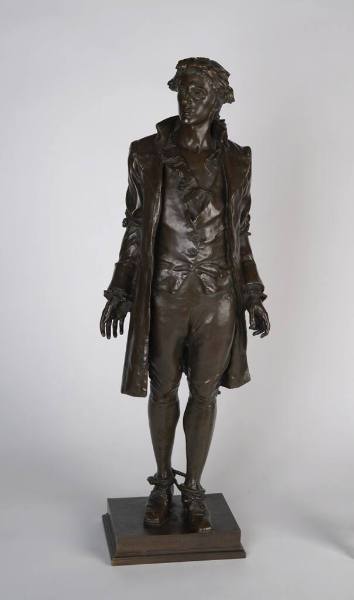
Nathan Hale
Artist
Frederick William MacMonnies
(American, 1863-1937)
Date1890
Mediumbronze
DimensionsOverall: 28 × 8 × 6 in. (71.1 × 20.3 × 15.2 cm)
Credit LinePurchased with funds provided by an anonymous donor
Exhibition History"The Medallic Art Collection of Bronzes," Medallic Art Company, no.59.
"Lasting Legacy: A Collection for Kalamazoo," Kalamazoo Institute of Arts, Kalamazoo, Michigan (Sep. 6, 2014 - Jan. 4, 2015).
"Unveiling American Genius," KIA Permanent Collection Exhibition, Traditional, Markin, Nay and Groos Galleries (March 1, 2021 - December 31, 2023).Label TextCreated by one of the best-known American sculptors of his era, Frederick MacMonnies was also an accomplished painter and portraitist. This maquette, or model, of Nathan Hale is one of his best-known works. In 1775, Hale–a 20-year old teacher, along with five of his brothers, served in the American Revolution against the British. Under General George Washington, Hale quickly became a captain and volunteered to spy against the British at the Battle of Harlem Heights in September 1776. Captured behind enemy lines, Hale was hanged as a traitor, without a trial.
Despite the rope encircling Nathan Hale’s elbows and ankles, MacMonnies’ imagining of the hero’s last moments skillfully captures his courageous and defiant last words: “I only regret that I have but one life to lose for my country.” Though facing death, the artist depicts Hale with a slightly upturned head and open hands, proudly accepting his fate.
[Label Text: For the People: America at 250 Exhibition, June 27 - October 4, 2026]
***************************
Nathan Hale was a young teacher serving in the Seventh Connecticut Regiment in the Revolutionary War when General George Washington sought a soldier to serve as a spy behind enemy lines. The only volunteer for the job, Hale’s responsibility was to report on British troop movements during the Redcoats’ invasion of Manhattan Island in September 1776. Captured behind enemy lines, Hale was hanged as a traitor without a trial. Reportedly, his final words were the now-famous quote: “I only regret that I have but one life to lose for my country.”
Frederick William MacMonnies was among the leading American sculptors of the late nineteenth and early twentieth centuries. Like many of the other most esteemed U.S. artists of this era, he made his reputation while living abroad in Paris, though he often completed commissions for American clients. This is a maquette for a life-size bronze that stands in City Hall Park in New York City at what is thought to be the site of Hale’s hanging. The statue shows the patriot with his wrists and ankles bound but his neck bare in preparation for the executioner’s noose. Hale stands defiantly, evidently prepared to deliver his defiant final words. The full-size statue was completed in France, shipped across the Atlantic, and unveiled on November 25, 1893 – Evacuation Day, the annual New York City celebration of the anniversary of the departure of the British Army from the city at the end of the war.