Balcomb Greene
From the Smithsonian American Art Museum: “Until the WPA was formed in 1935, Greene made a precarious living writing for two sensationalist newspapers, Broadway Brevities and Graft. After joining the WPA, he painted abstract murals for the Hall of Medicine at the 1939 New York World's Fair and for the Williamsburg Housing Project, and he designed a stained-glass window for a school in the Bronx. About 1940, Greene began working on a master's degree in art history at New York University. In 1942, he accepted a post at Carnegie Institute of Technology in Pittsburgh, where he taught art history until 1959. The Pittsburgh move did not mean cutting New York ties for the Greenes. The couple commuted between the two cities, and in 1947 purchased land at Montauk Point, Long Island, where they spent as much time as possible.
It was not until the 1950s that Greene began to exhibit with any frequency. He had shown his earliest paintings—mixtures of realism, fantasy, and incongruous stylistic elements— in Paris in 1932. His work was featured at J.B. Neumann's New Art Circle in 1947, and in 1950, Greene began exhibiting at the Bertha Schaefer Gallery in New York. By this time his painting had undergone a fairly dramatic stylistic shift. During the 1930s, Greene worked with angular, geometric planes, intersecting and overlaying color to create distinctive spatial configurations. Completely nonobjective, his forms often functioned as objects in space, their perspectives controlled through the juxtaposition of diagonal and rectilinear structure. Greene often worked out compositions by making small paper collages, such as the Untitled works identified as "34–8", "35–4", "35–7", and "39–03". Intended as preparatory studies, these collages represented a thinking-through process and lack the surface finish that characterized his oils.
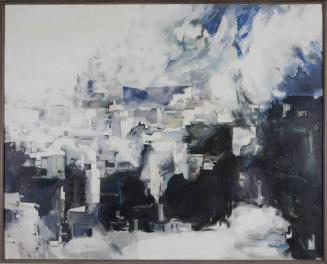
Around 1943, Greene again began using the human figure in his work. Although not conscious of Surrealist influences, Greene's odd merging of geometric space with organically abstracted human figures—evident, for example, in Way Down Blue of 1945— represents a distinctly Surrealist impression. By the late 1940s, Greene began a clear transition to the figurative style for which he is now well known. Light entered his work as an abstract compositional device, as did a desire to reflect fundamental humanist concerns. Beyond his involvement in artists' groups and his own paintings, Greene contributed significantly to the modernist cause through his eloquent and perceptive essays. He believed that the artist had a special gift for speaking directly to the individual:
It is actually the artist, and only he, who is equipped for approaching the individual directly. The abstract artist can approach man through the most immediate of aesthetic experiences, touching below consciousness and the veneer of attitudes, contacting the whole ego rather than the ego on the defensive.
He also argued specifically for a new language in art:
Without denying that [the artist's] ultimate aim is to touch the crowd, he sees the futility of addressing it in the language commonly used by the crowd. He must employ his own language … in order to move, dominate and direct the crowd, which is his especial way of being understood. … The point in abstractionism, actually, is that the function of art and the means of achieving this function have been for the first time made inseparable.